
Kattumaram Sri Lanka: What Is This Traditional Fishing Craft?
Along parts of Sri Lanka’s coastline, fishing has traditionally depended on remarkably simple craft designed for local seas, lagoons and fishing grounds.
One of the most interesting is the kattumaram.
It also explains the surprising origin of a word now used for a very different type of boat: catamaran.
What Is a Kattumaram?
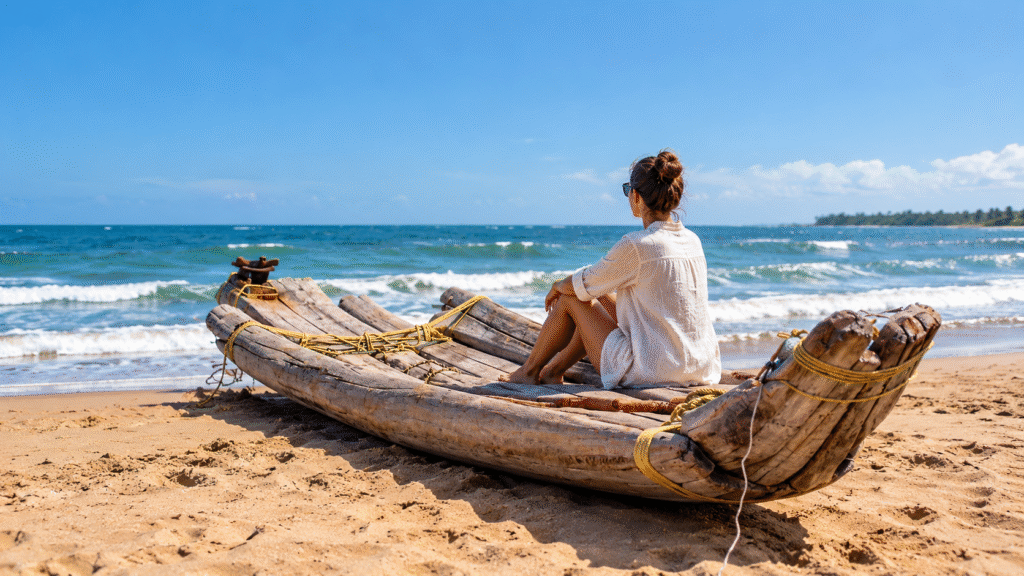
A traditional kattumaram is essentially a shaped-log raft.
Rather than building a hollow hull from wooden planks, fishermen created the craft using several shaped logs placed alongside one another and secured together.
Historical descriptions of Sri Lankan kattumaram commonly refer to craft made from around three to five logs, although construction and dimensions could vary.
What Does Kattumaram Mean?
The name provides a clue to its construction.
Kattumaram comes from Tamil. Kattu refers to tying or lashing, while maram means wood or tree.
In simple terms, the name describes wood that has been tied together.
Is Kattumaram the Origin of the Word Catamaran?
Yes, but there is an important difference.
Today, however, most travellers hearing “catamaran” picture a modern vessel with two separate parallel hulls.
That is not what the original kattumaram was.
A traditional kattumaram Sri Lanka fishing craft was a raft made from shaped logs lashed together. The modern twin-hulled catamaran therefore shares the name’s linguistic history, but not the same basic construction.
How Was a Kattumaram Built?
Several carefully shaped logs were positioned together and secured using lashings. Historical examples could also include a shaped bow section, and larger kattumaram could be equipped with a sail.
Sri Lankan maritime research distinguishes between two related traditional log-raft forms: the larger kattumaram, made from lashed logs, and the smaller theppam, where logs were joined differently.
Where Were Kattumaram Used in Sri Lanka?
Although traditional fishing craft varied considerably around the island, kattumaram were especially associated with northern and northeastern Sri Lanka.
Historical fisheries records show their strongest distribution in the north and northeast, with smaller numbers occurring elsewhere.
Pasikuda sits farther south along this same broad east-coast landscape. Travellers interested in experiencing more than the resort shoreline can explore the area’s beaches and nearby communities through these hidden gems near Pasikuda.
What Was the Kattumaram Used For?
Its main purpose was fishing close to shore.
Historical fisheries descriptions identify log rafts such as kattumaram and theppam as craft operating in inshore waters and lagoons. Depending on the craft and period, propulsion could involve paddles or oars, sails and, in more recent times, small outboard motors.
Their relatively simple form also made them suitable for launching directly from beaches.
Fishing communities could use traditional craft to reach nearby fishing grounds and return with their catch without requiring a harbour.
This connection between coastal communities and the sea remains part of the wider experience of Sri Lanka’s east coast. Travellers can explore more of the region through this guide to Pasikuda and Sri Lanka’s eastern coastline.
Can You Still See Traditional Fishing Craft?
Sri Lanka’s fishing industry has changed considerably.
Fibreglass boats, engines and larger mechanised fishing vessels have transformed how many communities work at sea. Traditional wooden craft are therefore not as dominant as they once were.
For another perspective on the area’s coastal culture, explore Food in Pasikuda: An East Coast Food Guide.
Why Does the Kattumaram Matter?
The importance of kattumaram Sri Lanka is not about the complexity of the vessel.
It is almost the opposite.
The craft demonstrates how a relatively simple combination of shaped timber, lashings and generations of maritime knowledge could produce a practical fishing vessel suited to coastal life.
Conclusion
Kattumaram Sri Lanka is part of a much wider story of traditional fishing around the island.
Built from shaped logs lashed together, the kattumaram was particularly associated with northern and northeastern coastal communities and was used for fishing in inshore waters.
For travellers exploring Pasikuda and the east coast, understanding craft such as the kattumaram adds another layer to the landscape. The beach is not simply somewhere to swim, it is part of a coastline shaped by generations of fishing, boatbuilding and life connected to the sea.